Showing posts sorted by relevance for query Felix. Sort by date Show all posts

Friday, May 05, 2006

Celebrity Sips

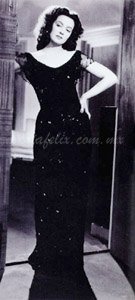
A Cinco de Mayo Tribute to Mexico's Film Icon, Maria Felix

Maria Felix, often referred to as the Marilyn Monroe of Mexico, earned fame as leading lady in nearly fifty movies. Renowned for her fashion sense and jet-setting image, her love life was as newsworthy as her career.

Widely agreed to be "the most beautiful face in the history of Mexican cinema,” she became a film icon during the golden age of the 1940s - a period of resurgent national pride - and the incarnation of the strong, sexual woman, who would, nevertheless, be tamed by machismo before the end of the movie.

Married four times, this Latin American femme fatale consorted with the rich and famous all her life. King Farouk of Egypt allegedly offered her Nefertiti's crown for one night of love.

Painted by many famous artists, including Jean Cocteau and Diego Rivera, (one of her numerous ex-lovers), who, to her fury, portrayed her in a transparent dress, she also inspired writers, including Paz and Carlos Fuentes. In 1990, an exhibition of paintings in Tijuana by her much younger Parisian lover, Antoine Tzapoff, included a portrait of her astride a rhinoceros.

In an interview Felix once said: "I cannot complain about men. I have had tons of them and they have treated me fabulously well. But sometimes I had to hurt them to keep them from subjugating me."

Born in 1914 in Alamos, northern Sonora state, she was one of 16 children of a wealthy family. She studied in Guadalajara, and later, moved to Mexico City. Her striking appearance - long, dark wavy hair and pale complexion – helped launch her film career, portraying strong women, endowed with intelligence and a voluptuous glamour.

In 1943, her lead character in Dona Barbara won her the life-long nickname “La Dona” with her public. Other well-known films include Rio Escondido and Enamorada, both released in 1947, and Luis Buñuel's Fever Mounts at El Pao (1959). In 1970, she starred in a television series, La Constitución (1970). Felix won three Ariel awards for best actress, and, in 1985, a lifetime achievement award and the Mexico City Prize.

Felix spent her later years living between Mexico City and Paris, where she owned a racehorse stable. Always dressed by top designers, in 1984, was nominated in France and Italy as one of the world's best-dressed women. In 1996, she became the first Latin American woman to be awarded France’s highest distinction, the National Order of Arts and Letters.
She published an autobiography, Todas Mis Guerras, in 1993. Asked once how old she was, Felix quipped: "I have been very busy living my life and haven't had time to count."

She died on her 88th birthday, April 8, 2002. Her body was paraded through Mexico City's Palacio de Bellas Artes, before burial.

Like Marilyn, her death had an air of mystery. Initially deemed a heart attack, her brother suggested that she had been poisoned. Her body was exhumed three weeks later. Finally, the family proclaimed she had died of natural causes and the matter was settled.

Mexican president Vicente Fox expressed the legacy of history and prestige Felix left behind her, "This was a great loss of a great Mexican that brought a great shine to our country…As an artist, she gave a huge world image to Mexico. There have been few of her stature and quality."

Drink a toast to the glamour of Mexican cinema!

Thursday, June 12, 2008

South of the Border in SoHo

Papatzul Serves Up Regional Mexican Specialties With A Side of Hospitality

Back in 1990, when I was a student at the American Aca
demy of Dramatic Arts, Manhattan had a different vibe. For one, I carried a “stun gun” a Puerto Rican acquaintance secured for me. (No questions asked, if you catch my drift...) I lugged that thing around in my pocket – cuz – truth be told, the city felt a bit menacing back then to a relatively wholesome kid from Santa Fe, New Mexico.

Needless to say, I was also on a budget. During that summer, I ate hot dogs from the street vendors, tried my first knish from a Jewish deli, and discovered that Queens was not the regal neighborhood I had envisioned. I also made friends with a local who took me to eat the worst “Mexican” food I’d had in my life. Soggy, saucy and insipidly NOT Mexican, I cringed to think that this was what the Big Apple had to offer when I longed for what I considered “comfort food.”

Fast forward 18 years… and not only is Manhattan transformed into a wonderland of safe streets packed with shiny, happy people and (mostly) friendly taxi drivers but there are actually some decent Mexican digs.

When I first saw Papatzul around the corner from the swanky SoHo Grand, where I recently spent a couple of weeks, I had my doubts. Mexican… in New York? Did I really want to take a risk when there are so many places I’d be guaranteed a good meal?

Well, it was HOT outside. And, nothing sounded quite as refreshing as a margarita. So, up the steps and into the bar I bellied.


The first thing I noted was the vast array of tequilas. I mean, this wasn’t one of those “we have 300 tequilas!” type of places. Nor do I need a place to offer that many. (I can only make it through about 3 drinks in a sitting, myself.) Still, it had a decent array of the tequilas I enjoy: Partida, Herradura, Milagro and the like. I also happened to have a bottle of certified organic 4 Copas in my bag (I was teaching The Liquid Muse Sustainable Sips earlier that night) and I gave the bartenders a taste. (I’m always happy to introduce people to a “greener” way of drinking, after all…).

The atmosphere at Papatzul is great because the staff is so friendly. Ashley, the bartendress, was a doll – and makes mean tamarind as well as hibiscus margaritas (pictured here). She also recommended that I try a specialty of the house …. Which are scrambled quail egg enchiladas in a nutty sort of sauce. It is a dish typical of a region near Mexico City, where the owner Thierry grew up.

Now, I know what you’re thinking – Thierry? Is this some froggy transplant passing himself off as “Latino?” No, Thierry Amezcua is from Mexico, though his mother is from France. My dad is from France, so we chattered away in French for a while, too. (Another surprise in this tiny corner of Manhattan.)

Some guy, sitting with two models at the bar, kept asking when Thierry was getting a DJ for Sunday afternoons. It seemed as if Thierry has put a lot of thought into this, and although it could be a good idea (Felix, kitty-corner from Papatzul serves French bistro fare while blasting Brazilian samba on the weekends as patrons spill onto the street, Caipirinhas in hand), I couldn’t help but think about Anthony Bourdain’s description of NYC restaurant owners desperately grabbing at any gimmick to lure the customers to their corner of the sidewalk. I hoped that wasn’t the case with Thierry – but, as we all know, the restaurant business is “perro eat perro.”

I went to many fancy and wonderful places during my two weeks in New York but I can assure you that Papatzul is the ONLY place where the owner of the joint sat down at the bar next to me, pulled up a chair and talked shop in between cooking customers’ orders. (Thierry is also the Executive Chef.) If I had the means to live at the SoHo Grand, or in SoHo for that matter, Papatzul would be my neighborhood hangout. The people are nice. The food is good. The margaritas are delicious. And, yeah, the neighborhood ain’t too shabby. Which is important because that stun-gun would never get through security at the airport these days…

Saturday, August 30, 2008

La Casa Azul

How better to get to know an artist than in
their own home?

While taking a self-guided recorded tour through the Blue House in Coyoacán, I got some insight into Frida Khalo’s existence. Born in 1907, she was one of the most intriguing feminist icons of the 20th Century.

Openly bisexual, Khalo endured a tumultuous marriage with an equally celebrated eccentric artist, Diego Rivera, whom she married in 1929, divorced in 1939 and remarried in 1940. She lived with him at La Casa Azul until her death in 1957.

Frida Khalo was one of four girls born to a German immigrant father and Mexican mother. Due to an unfortunate series of mishaps – polio as a child and a serious bus accident when she was 18, Khalo was sometimes wheel chair bound, and I couldn’t help but wonder how she managed up and down the many stairs in the home.

In addition to painting, Khalo loved to sew and some pieces of clothing are on display in the home. She was also an avid reader on topics ranging from science to philosophy to politics and culture. She and Rivera mingled with North American and European famosos, such as Mexican film star Maria Felix and Russian revolutionary Leon Trotsky, who are alluded to around the house. Andre Breton invited her to do an exhibition in Paris in 1939, and the Louvre bought The Frame, which according to Wikipedia is “the first work by a 20th century Mexican artist ever purchased by the internationally renowned museum.”

Visitors are not allowed to take photos inside the home, so I shot some around the exterior of the house and in the lush courtyard.

I hope you enjoy this peek into an important piece of Mexican pop culture and history as complementary reading material with your favorite south of the border libation! There is a Frida Khalo tequila, which I have yet to try - but I have been sampling my share of Cazadores tequila down here and highly recommend it.